
- Published on
- ·6 min read
Riverpod vs Bloc — How to Pick the Right State Management for Your App
- Authors

- Name
- Bert / DOTUNE
- Developer
Flutter's state management story doesn't actually start with Flutter.
If you trace it back, Flutter's Widget-Element-RenderObject tree was heavily inspired by React's Virtual DOM and component model. The web frontend world had already gone through a decade of state management battles — Redux, MobX, Zustand, Recoil, Jotai — each a different answer to the question of "how should state flow through an app?"
Flutter took its own path. From raw setState, to Google-backed Provider, to where we are now — a scene that's largely consolidated around two players: Riverpod and Bloc.
They're the two most popular options, but their philosophies couldn't be more different. So which one's right for you? Let's break it down.
Quick Primer: MVC and MVVM
Before we get to Riverpod and Bloc, let's refresh two architecture ideas that get thrown around a lot but actually matter here.
MVC (Model-View-Controller)
One of the oldest UI patterns. Model holds data. View draws the screen. Controller orchestrates. The problem? The line between View and Controller gets blurry fast, and the Controller usually turns into a dumping ground for everything.
MVVM (Model-View-ViewModel)
MVC's evolution. The ViewModel transforms Model data into something the View can consume directly — the View just renders, zero business logic. This "separate View and logic completely" idea directly shaped every Flutter state management approach that followed.
Bloc and Riverpod are both descendants of MVVM. They just took different roads.
Bloc — Structure You Can Enforce
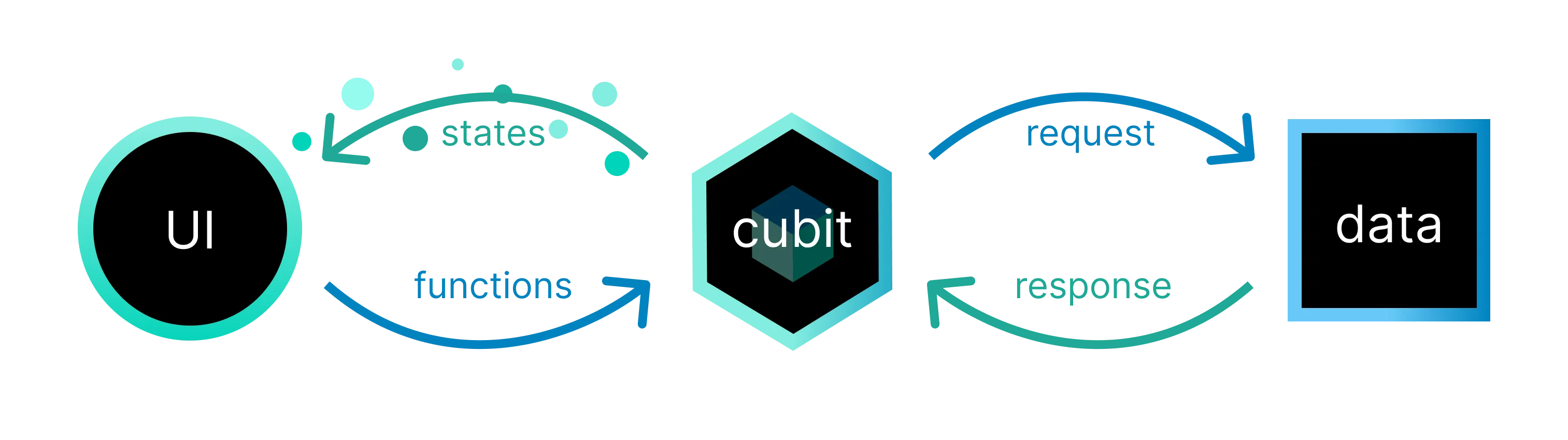
Bloc is event-driven at its core. The UI never touches state directly. Instead: UI dispatches an Event → Bloc processes it → Bloc emits a new State → UI rebuilds. One-direction data flow. Clean, no going back.
Its most distinctive design choice: Blocs can't talk to each other. This is intentional, not an oversight. You cannot listen to Bloc B's state changes from inside Bloc A. If you need cross-Blocs communication, you either merge them or route through a Repository layer.
Why impose this constraint? Felix Angelov (Bloc's author) had a clear goal: make every state transition traceable, loggable, and replayable. Bloc ships with BlocObserver, which gives you global visibility into every Event entering and every State exiting the system. For apps that need audit trails, logging, or deterministic debugging, this is invaluable.
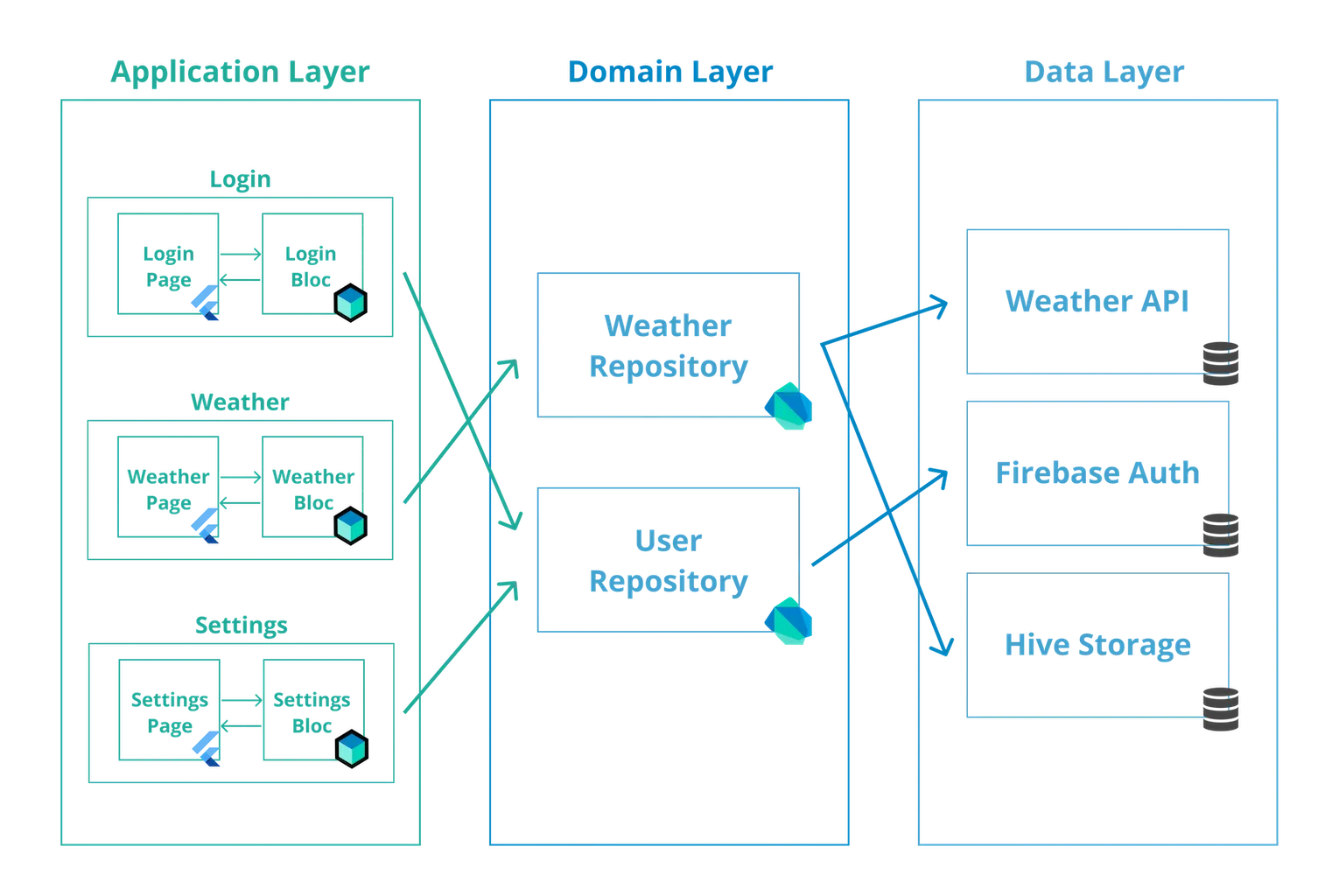
This is also why Bloc gets paired with Clean Architecture so often. The Bloc → Use Case → Repository layering, combined with Event/State's strict unidirectional flow, turns your app's data flow into something you can literally draw on a whiteboard. On a large team, that diagram becomes shared language.
Where Bloc shines:
- Apps that need event tracking and audit logs (fintech, compliance) — each Event is a natural audit trail entry
- Business logic that mirrors a state machine — form validation, order flows, multi-step wizards
- Large teams where you need the framework to enforce consistency, not just team conventions
Where Bloc chafes:
- Blocs can't communicate directly — cross-module interaction requires either merging Blocs or routing through Repositories
- The Event/State/Bloc trifecta means even small features spawn multiple files. AI can write them, but during maintenance you're jumping across more files than a single-provider setup
Riverpod — Flexibility Born from the Trenches
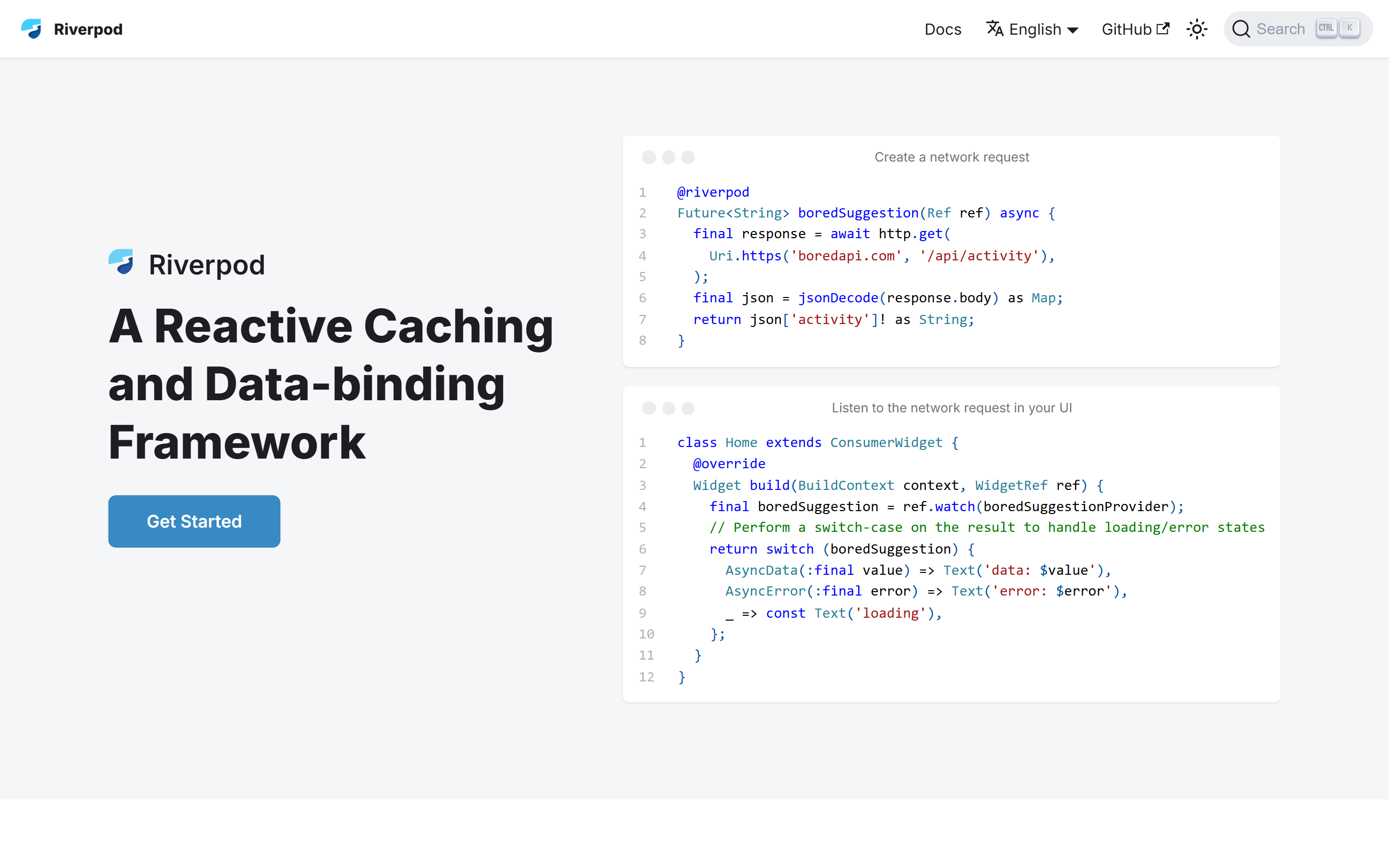
Riverpod was created by Rémi Rousselet — the same person who wrote Provider.
Provider's problems were well-known: tightly coupled to InheritedWidget (thus BuildContext), only one provider per type, crude lifecycle management. Rousselet knew the issues, but fixing them meant breaking changes. So he started fresh and named it Riverpod (an anagram of Provider).
Riverpod's design comes from the trenches, not from a whiteboard. Its core decisions:
- No BuildContext dependency — you can use providers in pure Dart code, outside the widget tree
- Compile-time safety — provider dependencies are checked at compile time. No runtime
ProviderNotFoundException - autoDispose — providers automatically clean up when nothing is listening. No manual lifecycle management
What really sets Riverpod apart from Bloc, though, is control over data granularity.
Riverpod lets you declare independent providers at any level of granularity — a single int, a String, a User object. These providers can watch each other via ref.watch: A depends on B, B depends on C. When C changes, A and B update automatically. It's a reactive dependency graph, no manual subscribe/unsubscribe needed.
This means Riverpod is dramatically more flexible than Bloc. You decide on the fly how finely to slice your state, what depends on what. You don't need to design a full Event/State architecture before writing a single line.
Where Riverpod shines:
- Complex dependency chains between pieces of state —
ref.watchhandles the propagation automatically - Frequent cross-module state sharing — providers live outside the widget tree, accessible from anywhere
Where Riverpod chafes:
- Flexibility means no enforced structure — three developers might wire up three different provider arrangements for the same feature. Your team needs its own discipline.
ProviderObserver(didAddProvider,didUpdateProvider,didDisposeProvider) can log state changes, but it logs "the value changed," not "why it changed." Bloc's Events carry that semantic payload. If you need a full Event → State audit chain, Bloc was purpose-built for it.
Which One When — At a Glance
| Scenario | Pick |
|---|---|
| State with complex interdependencies, fine-grained reactivity | Riverpod — ref.watch auto-tracks, no manual wiring |
| Need Event → State audit trail, full operation log | Bloc — Events carry semantic meaning, Observer records causality |
| Business logic is inherently a state machine (forms, orders, wizards) | Bloc — Event/State mapping mirrors the domain directly |
| Frequent cross-module state sharing | Riverpod — no BuildContext, works in pure Dart |
| Large team, need architectural guardrails | Bloc — the rules are baked into the framework, not just the README |
| Using Bloc for interdependent state listening | Pain. Blocs can't talk. You'll be routing around it. |
| Using Riverpod for full Event-audited systems | Less painful (ProviderObserver helps), but you're supplying the event semantics yourself |
What About the Other Options?
- GetX: Convenient, but too much magic under the hood. When something breaks, you can't find the culprit. Fine for toy projects; stay away for anything serious.
- MobX: Reactive, elegant concepts, but a tiny niche in the Flutter ecosystem. Good luck finding answers when you're stuck.
- Vanilla
setState: If your state lives within a single screen, just use it. Don't reach for a framework just because you can.
Riverpod and Bloc are both excellent tools. The point isn't to pick a side — it's to understand both well enough to know which one to pull out for which problem. Know where each one constrains you and where each one sets you free. That way you won't get buried in Bloc boilerplate when you needed flexibility, and you won't find yourself missing Event traceability when the auditors show up.