
- Published on
- ·5 min read
Flutter × Rust: The Best Cross-Platform Stack in 2026
- Authors

- Name
- Bert / DOTUNE
- Developer
Here's the short version: if you need to ship on iOS, Android, Web, and Desktop, and you want the most platform coverage per line of code — Flutter for UI and Rust for the heavy lifting is as good as it gets right now.
Let me show you why, with real comparisons.
The Cross-Platform Lineup, Ranked
In 2026, these are your choices:
React Native
JavaScript ecosystem, huge community, easy to get started. But the Bridge architecture has a ceiling you'll feel — the UI thread and JS thread have to talk through a serialization layer, and that overhead shows up the moment you hit complex animations or heavy data. The New Architecture helps, but Flutter still has a fundamental edge: it draws pixels directly. No browser engine, no bridge tax.
Kotlin Multiplatform (KMP)
Share business logic, write your UI natively per platform. Teams that insist on platform-native UI love this — but the catch is, you're still maintaining two UI codebases (SwiftUI and Compose). It's cross-platform, sort of. The development-effort-to-user-reach ratio just isn't great. And after years of hype, KMP adoption never really took off the way people expected.
Pure Native — Swift + Kotlin, Two Codebases
The best performance, the fullest platform APIs. Also: two codebases, two teams, twice the time. Unless your budget is effectively unlimited, solo devs and small teams shouldn't even have this on the table.
Flutter
One Dart codebase → iOS, Android, Web, Desktop. Performance is near-native because Flutter owns the pixels — no platform bridge, straight to the GPU. It's been around since 2018, the ecosystem is solid, and Google runs Google Pay and Google Home on it.
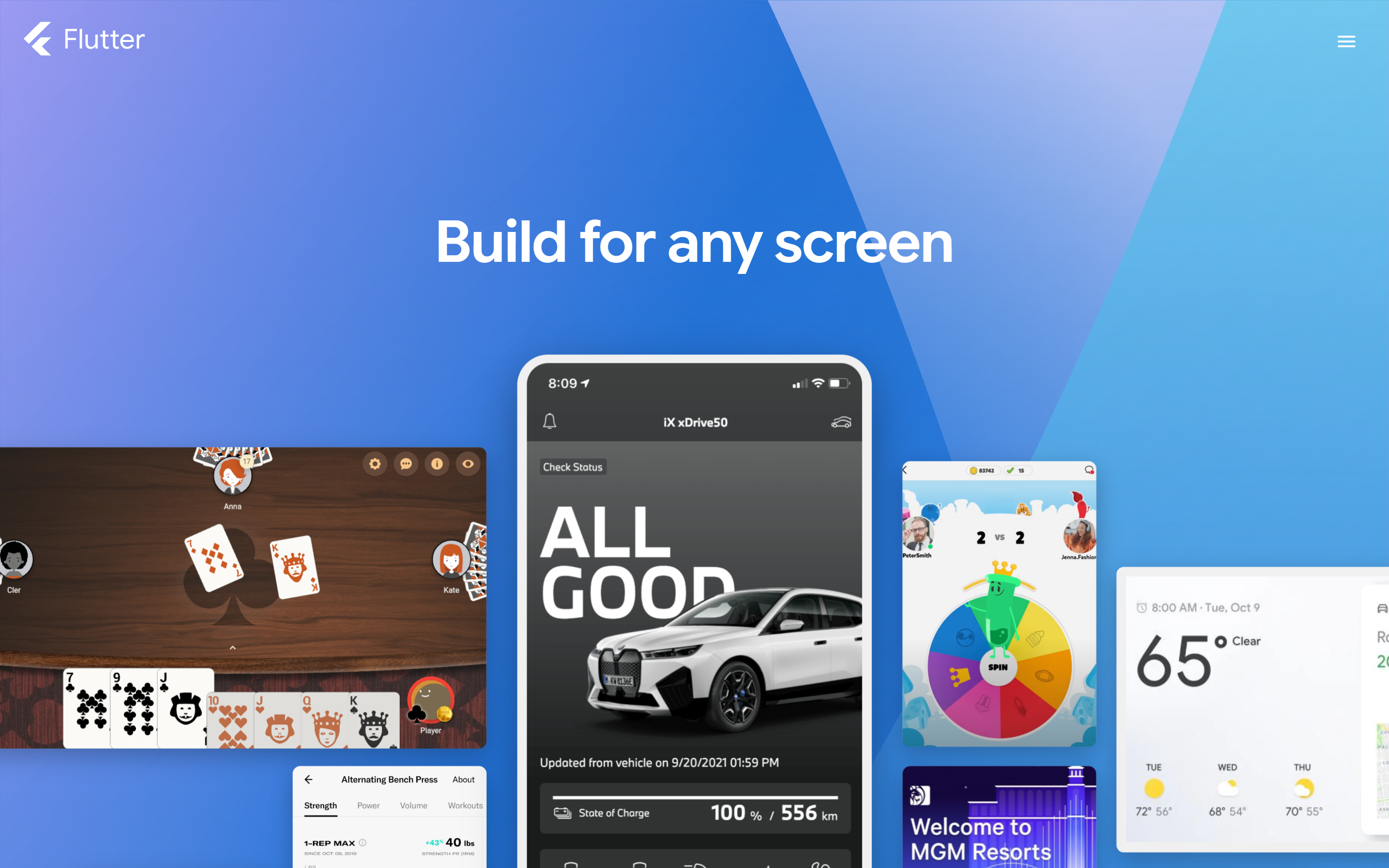
Flutter's ceiling is real, though: it's not built for CPU-bound work, real-time processing, or low-level hardware talk. Dart has isolates for parallelism, but they aren't the same as native threads. Audio processing, BLE communication, video encoding, on-device ML inference — these need actual native speed.
And Rust happens to be perfect for exactly that.
What Rust Adds
Two things: C/C++-level speed, zero memory headaches. No garbage collector — no GC pauses stealing your critical thread mid-frame. Zero-cost abstractions — the ergonomic code you write compiles down to the same performance as carefully hand-tuned low-level code.
The detail that matters most for Flutter devs: Rust compiles to the C ABI. Any platform that can call a C function can call Rust. That turns Rust into the ideal portable engine — write your performance-sensitive logic once, and every target (iOS, Android, Desktop) shares it.
How They Wire Together
The old ways were painful. Platform Channels meant Dart ↔ Kotlin/Swift with serialization gymnastics. Raw FFI meant Dart ↔ C with manual memory management and sharp corners everywhere.
flutter_rust_bridge changes the game. You write your Rust functions, it auto-generates type-safe Dart bindings. Async, streams, complex structs — all handled. The workflow is dead simple:
- Write the logic in Rust, compile to a native library per platform
- The bridge spits out Dart wrappers that are type-safe
- Call them from Flutter like any other Dart function
Where This Stack Actually Wins
Platform coverage — this is the main one
You write one Rust core + one Flutter UI, and you're on iOS, Android, Web, macOS, Windows, and Linux. Compared to pure native, you've cut your dev effort at least in half. Compared to React Native, your performance ceiling is in a different league. If the metric is "most users reached per developer-hour," nothing else comes close.
Where else it shines
Real-time audio, IoT hardware comms, large file ops, on-device AI — I'll write these up in dedicated posts. The pattern is the same every time: you need near-native speed, and the logic shouldn't be locked to one platform.
"But what about the learning curve?"
Honestly? AI ate most of it.
The old argument against Flutter + Rust was the up-front complexity — the Rust toolchain, cross-compilation targets, bridging boilerplate, debugging across language boundaries. It was real.
In 2026, it's mostly gone. Rust build scripts, platform config, flutter_rust_bridge wiring — throw it at an LLM and it comes back working. Like I said in another post: hours spent reading docs and fighting toolchains have turned into a single conversation.
Same goes for CI/CD. Multi-platform build pipelines, code signing, store uploads — hand it to AI. I covered this in the App Store piece.
The "cost" of Flutter + Rust isn't a real blocker anymore. What's left is the upside — and it's substantial.
The Bottom Line
Flutter + Rust is the best stack for cross-platform development in 2026. Not because Flutter is the best UI framework or Rust is the best systems language — but because put together, no other combo beats them on the metric that matters: platform coverage × performance ceiling × team efficiency.